
Written By:- JAIN (Deemed-to-be University) : Editorial Team
In today’s interconnected world, logistics and supply chains are no longer operational support units—they are strategic engines that influence profitability, competitiveness, customer experience, and organisational resilience. As industries deal with rapid digitalisation and persistent global uncertainties, the demand for professionals who can manage, lead, and optimise supply networks has grown stronger than ever. An MBA in Logistics and Supply Chain Management has therefore become a specialised pathway for learners who want to build managerial depth, analytical clarity, and cross-functional leadership in this domain. (University/program name mentioned once here, organically.)
- The Shift From Operations to Leadership in Modern Supply Chains
- Logistics as a Strategic Driver of Business Competitiveness
- Planning, Control, and Real-Time Coordination
- How Organisations Build Resilience
- Wider Economic Effects of Supply Chain Instability
- Trends That Are Redefining Global Logistics
- Academic Depth of a Supply Chain-Focused MBA
- FAQs
- Final Takeaway
The Shift From Operations to Leadership in Modern Supply Chains
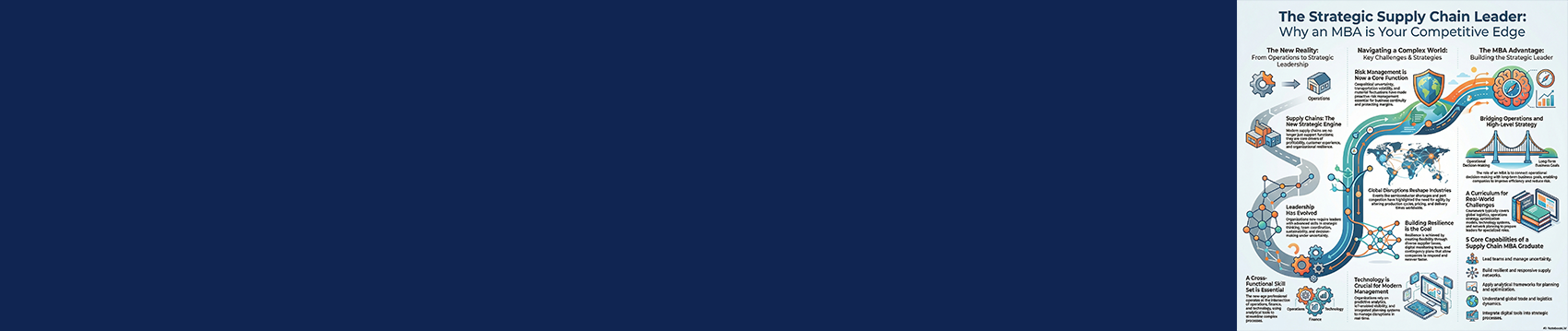
The nature of supply chains has changed fundamentally. Organisations now expect managers to demonstrate advanced supply chain leadership skills, which include strategic thinking, team coordination, sustainability understanding, and decision-making under uncertainty. The supply chain leader of the future must be able to interpret data, anticipate bottlenecks, and guide multi-functional teams towards efficiency and risk-aware outcomes. What defines the new-age supply chain professional? Strong supply chain management skills include the ability to analyse demand patterns, understand procurement cycles, manage vendor relationships, and improve distribution efficiency. These professionals work at the intersection of operations, finance, and technology, and are expected to streamline processes using both analytical tools and practical industry insight.
Key takeaway
- Modern supply chains reward professionals who combine conceptual knowledge with technology-enabled coordination.
Logistics as a Strategic Driver of Business Competitiveness
As global trade evolves, the timely movement of goods is critical for business success. Professionals with strong logistics management skills manage warehousing flows, transportation decisions, shipment consolidation, documentation, and compliance. Their effectiveness directly influences delivery performance, cost optimisation, and customer satisfaction. Supply chains rarely follow a predictable rhythm. Demand surges, supplier delays, and route disruptions require leaders to excel in supply chain decision making, where choices must be guided by timely data, scenario analysis, and organisational priorities. This decision-making ability differentiates operational managers from strategic supply chain leaders.
Planning, Control, and Real-Time Coordination
Efficient network operations depend on accurate supply chain planning and control, where forecasting, scheduling, capacity alignment, and inventory optimisation work together. This planning ensures that every stage—from procurement to last-mile delivery—remains integrated, cost-efficient, and aligned with business goals. Why has risk management become a core supply chain function? Geopolitical uncertainty, raw material fluctuations, transportation volatility, and technology failures have made supply chain risk management essential. Businesses must continuously identify risks, assess their impact, and establish mitigation plans to maintain continuity and protect margins.
How Organisations Build Resilience
Strengthening supply chain resilience involves building flexibility across sourcing models, implementing digital monitoring tools, diversifying supplier bases, and designing contingency structures. Companies that invest in resilience can respond faster and recover sooner during disruptions. The scale and impact of global disruptions in semiconductor shortages, port congestion, and geopolitical conflicts have created unprecedented global supply chain disruptions that reshaped production cycles, pricing structures, and lead times. These events highlighted the need for organisations to be agile rather than reactive. Modern tools such as predictive analytics, IoT-enabled visibility, and integrated planning systems are now essential for managing supply chain disruptions. Organisations rely on these technologies to assess real-time constraints, reroute shipments, adjust production schedules, and communicate faster with partners.

MBA (Logistics and Supply Chain Management Elective) For Students and Working Professionals
Duration - 2 Years
Wider Economic Effects of Supply Chain Instability
The impact of global disruptions on supply chains extends to inflation trends, global trade agreements, commodity availability, and manufacturing competitiveness. This indicates that supply chain stability is not just an organisational concern—it shapes national and international economic landscapes. A robust supply chain strategy integrates technology, sustainability, supplier collaboration, and workforce development. Companies now prioritise digital visibility, automation, and strategic sourcing to create long-term competitive strength. Rising fuel prices, shortage of skilled professionals, regulatory complexities, and technological gaps are some of the major logistics and supply chain challenges. Managers must balance cost control with service-level expectations and operational continuity.
Trends That Are Redefining Global Logistics
Key logistics and supply chain trends include automation in warehouses, green logistics initiatives, predictive analytics in demand forecasting, and blockchain-based tracking. These shifts are reshaping traditional models and introducing new career pathways. Understanding supply chain management in the global economy involves studying international trade dynamics, cross-border regulations, currency fluctuations, and production decentralisation. This perspective helps professionals navigate global risks and opportunities effectively. An MBA in SCM and logistics enhances managerial, analytical, and strategic perspectives across procurement, operations, distribution, technology adoption, and supplier partnership. Learners gain the capacity to manage high-stakes environments with clarity and confidence.
Academic Depth of a Supply Chain-Focused MBA
A supply chain management MBA typically includes coursework in global logistics, operations strategy, optimisation models, sourcing, technology systems, and network planning. This academic foundation prepares learners for specialised roles across industries. The role of MBA in supply chain management is to connect operational decision-making with organisational strategy—enabling companies to improve efficiency, reduce risks, scale sustainably, and align supply networks with long-term business goals.
FAQs
How does an MBA in Logistics and Supply Chain help professionals handle disruptions?
+An MBA strengthens a professional’s ability to analyse risks, interpret real-time data, and respond quickly when operations are affected. The curriculum builds decision-making skills, teaches disruption-response frameworks, and introduces digital tools used for forecasting, visibility, and contingency planning. This prepares managers to stabilise supply flows, reroute logistics, and adjust strategies during unpredictable situations.
How do global disruptions affect logistics and supply chains?
+Global disruptions create delays, capacity shortages, cost fluctuations, and an imbalance between supply and demand. They can slow production cycles, increase transportation challenges, and reduce inventory availability across industries. These disruptions also impact pricing, customer service levels, international trade routes, and long-term business planning.
Why is supply chain risk management important today?
+Supply chain risk management is essential because organisations operate in an environment shaped by uncertainty—geopolitical shifts, climate events, material shortages, and regulatory changes. Risk management helps identify vulnerabilities, evaluate potential impact, and build mitigation plans that protect continuity, cost efficiency, and customer commitments. Without a structured risk approach, disruptions can escalate quickly and affect overall business performance.
Can working professionals apply MBA supply chain concepts in real situations?
+Yes. The concepts taught in an MBA—such as forecasting, planning, optimisation, supplier coordination, and technology-enabled monitoring—directly translate to real operational scenarios. Working professionals can apply these frameworks to improve warehouse efficiency, manage procurement cycles, enhance logistics routing, reduce delays, and strengthen vendor relationships. The learning is practical, relevant, and immediately usable in day-to-day decision making.
Final Takeaway
A specialised MBA in Logistics and Supply Chain Management prepares professionals to:
- Lead teams and manage uncertainty
- Build resilient and responsive supply networks
- Apply analytical frameworks in planning and optimisation
- Understand global trade and logistics dynamics
- Integrate digital tools into operational and strategic processes
Need Help Deciding on Your Next Career Step? We're Here to Guide You!
.png)
Chat with Us
Our counselling team is ready to assist you at every step — click the button below to get started.
.png)
WhatsApp Assistance
Need advice? Our experts are on WhatsApp 24/7—message us anytime!